vk nardep
 
Home Services Cost Effective Construction

Cost Effective Construction


Green Building Technology Camp PDF Print E-mail
Green Building Technology Training Camp

Dear Friend,

We are happy to inform you that we are organising Three day workshop on the above subject on 09th Aug. to 11th Aug. 2009, at Rural Building Center, Anjaneyapuram (Kalluvilai village) Kanyakumari. The details are as follows:-

1. Syllabus : Based on the concept note above

2. Dates : 09th Aug to 11th Aug, 2009 (Sunday,Monday & Tuesday)

3. Venue : Rural Building Center, Anjanayepuram, Kalluvilai, Kanyakumari.

4. Target group : Engineers and Architects

5. Medium of instruction : Tamil/English

6. No. of participants : 20 nos.

7. Guide map : given below

In case of difficulty please contact reception, Vivekanandapuram, Kanyakumari.

8. Methodology : (i) Classroom session

(ii) Demonstrations / Practical

(iii) Discussions

(iv) Audio visual – CDs

9.Trainers : The training Team Comprises faculty from Pune and Chennai

10. Course fees : (i) This is Residential Training Course. The Entire training, lodging and Board is free.

(ii) A Simple dormitory accommodation will be provided. However, Trainees will have

to pay nominal registration fees of Rs.200/-

11. Last date for

Registration : First cum First basis as the seats are limited. Application form stating educational qualification and experience as well as registration fees by way of DD/M.O should reach before 5th August,2009.

12. Course material : material kit will be provided.

13. Time of arrival : Participants should reach our TRC by 9 a.m. on 09th Aug,2009

14. Time of departure : Participants will be free to leave the place on 11th August at 4.00 p.m.

With best wishes,

(V.Ramakrishnan)

Concept and Syllabus

Concept Note : “Green Architecture”

Green architecture is an approach to building which has become more popular in the last 25 to 30 years. Also known as sustainable design, green architecture is a method of design that minimizes the impact of building on the environment. Once thought of as unconventional and nonstandard, both regulatory agencies and the public alike are quickly accepting green architecture as a socially responsible and logical means of construction.

The beginnings of today's green revolution can be traced back to the environmental awareness of the 1960s and European design. New construction techniques have lead to the development of innovative materials and design concepts. Green buildings are designed, constructed and commissioned to ensure they are healthy for their occupants. Successfully designed green projects can involve an extensive array of factors, ranging from the resourceful use of materials, to careful consideration of function, climate, and location.

The concepts about green architecture can generally be organized into several areas of application. These areas include sustainability, materials, energy efficiency, land use, and waste reduction.

Green buildings are not only designed for present use, but consideration is also been given to future uses as well. An adaptable structure can be "recycled" many times over the course of its useful life. If specific technical issues prevent use of the building for a new function, then the materials used in its construction are designed to facilitate ease of recycling and reprocessing of materials.

Buildings consume a variety of materials in their construction. Green design reduces the dependence on resource intensive products and materials. Today, there are an increasing number of products available made from efficient, earth-friendly, or recycled materials. In a green building, consideration is also given to the construction process itself. Materials that minimize waste or can be recycled, help contribute to an efficient and environmentally sensitive construction process.

Another important aspect of green architecture is the integration of energy efficient mechanical systems and conservation methods. Green buildings are designed to reduce or eliminate the dependence on fossil fuels. Additionally, green designs further help to minimize waste through the use of gray water recycling and other sustainable energy strategies. Grey water is conserved or saved to be recycled to water gardens.

Land use and building orientation also plays a critical role in green architecture. A green building is located to take advantage of its climate and surroundings. These conditions not only affect the efficiency of a building, but of the community and society as a whole. Planning for responsible land use addresses these issues through the consideration of climate, transportation, and the natural environment.

An amazing amount of waste is generated by the construction of a typical building. Green buildings are designed to eliminate waste by using modular systems of construction, recycled products, and efficient use of materials. The ideal green building would create no waste either during construction or use, so the impact on the environment and resources is minimized. Environmentally sensitive development at all levels housing, commercial and institutional appears to be a very promising approach to help achieve sustainability in these terms. Humanity shares a common need for affordable, healthy, durable, comfortable housing and workspaces designed and built to maintain or uplift the human condition. Unfortunately this does not yet frequently occur as a rule throughout the World.

Over the next 10 to 20 years, accelerated movement toward a more sustainable economy and infrastructure will be needed, to head off environmental problems such as global climate change, enlargement of the Ozone "hole," possible food-chain disruption and depletion of ocean fisheries, top-soil depletion and erosion, desertification, and ground water contamination.

Keeping the above points Architects and engineers have to play major role in reducing green house gases. Unfortunately many Engineers and architects do not understand the seriousness of the issues.

Following Topics will be covered

v Climate Changes and Carbon credits

v Embodied Energy, Operational Energy and Life Cycle Assessment.:

v Energy Audit and survey

v Calculating energy from the modal home.

v Eco-friendly construction practices.

v Renewable energy systems for efficient home.

v Roof water harvesting

v Waste water treatment

v Eco sanitation

v Solid waste management.

v Case studies and

v Field visit.


Last Updated on Wednesday, 17 February 2010 04:40
 
Where VK-NARDEP is today... PDF Print E-mail
Today VK-NARDEP is a pioneer in the State in innovation and propagation of cost-effective building technologies.
    The Policy Note of the Rural Development Department of Tamil Nadu government identifies VK-NARDEP as “Institute of National Repute in cost-effective construction technology” for promoting appropriate technology in building activities.
    HUDCO also recognizes VK-NARDEP as an important partner in propagation of cost-effective technologies.
    This cost-effective construction technology disseminated and innovated by VK-NARDEP also reduces the use of materials that result in Green House Gas emission. As Carbon Crediting system becomes important rural communities which benefit from VK-NARDEP construction  technologies also accumulate carbon credit for the nation.
 
Construction Technology PDF Print E-mail

Eco-friendly, Cost effective construction technologies

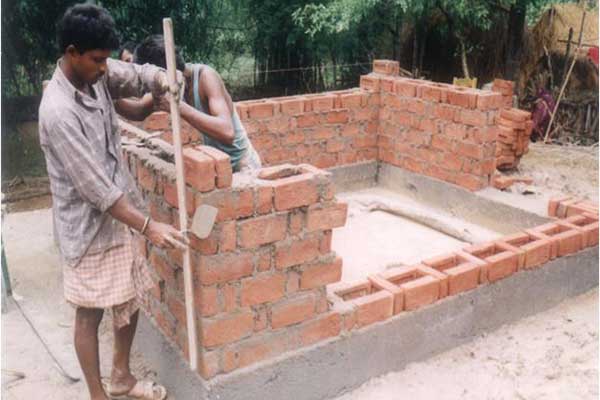
In the case of conventional building technology the cost of construction is as of now Rs 450 per square feet. But in the case of cost-effective and eco-friendly construction the cost comes to Rs 300 per square feet.A functional demonstration of cost-effective construction is the Avuai Agam - a building belonging to Amuthasurabhi Self Help Group Federation for rural women. An aesthetically pleasent building it incorporates various salient features of cost-effective technologies that VK-NARDEP propagates. Some of these include:
Walls: Bricks made of FAL-G (Flyash Lime and Gypsum bricks) First quality bricks with compressive strength of 120 kg per square cm.
Flooring: Traditionally polished with red oxide
Doors: Ferro-cement doors which are aesthetically pleasing and eliminates timber - saving the trees.
Roofing: Ferro-cement roofing channel with one-side width more than the other.

Some important building technologies disseminated by VK-NARDEP:
Arch Foundation – Economical and Strong
Rat trap bond – Best Masonry work for walls
Compressed Earth Blocks – Best substitute for bricks
Flyash bricks : Recycling waste to wealth
Cost effective filler slab roofs
Ferro-cement channels for roofing
Arches and Corbels
Vaults and Domes
Ferro-cement door and window shutters
Brick Jalis and ventilators.


Tamil Nadu Government recognises VK-NARDEP as a center of excellence in disseminating the cost-effective construction technology

Last Updated on Saturday, 03 January 2009 10:08


Subscribe to Newsletter


Receive HTML?


Saturday
July 2010
31
Ulti Clocks content